
Skip to content
Think Crew Support

Think Crew Support

Answers to all of your questions

Account Management

3
  • Subscription Plans and Billing
  • Managing Your Subscription
  • Password Management

Collaboration Features

2
  • Team Collaboration Overview
  • Managing User Permissions

Devices & Internet

3
  • Using Think Crew on Mobile Devices
  • Running Think Crew from Your Desktop
  • Offline Access and Synchronization

Internationalization

4
  • Language Settings and Preferences
  • Available Languages and Translations
  • Setting Measurement Preferences
  • Date and Time Format Customization

Overview

14
  • Introduction to Think Crew
  • System Requirements and Browser Compatibility
  • Creating Your Account
  • Quick Start Guide
  • Navigating the Interface
  • Customizing Your User Profile
  • Your User Page
  • Search
  • Alerts
  • Understanding the Dashboard
  • Permissions Page
  • Keyboard Shortcuts and Time-saving Tips
  • Feature Requests
  • Report an Issue

Progress Reports

1
  • Progress Reports

Projects

6
  • Creating a New Project
  • Projects Page Overview
  • Managing Project Settings
  • Deleting Projects
  • Adding Users to Projects
  • Setting User Permissions

Schedule Page

44
  • Schedules Page Overview
  • Managing Panes (Tab Pane System)
  • Managing Schedule Scenarios
  • Creating and Managing Calendar Events
  • Printing Schedules
  • Schedule Settings
  • Boards
    • Board Views (Strips, Calendar)
    • Working with Boards
    • Recycle Bin
    • Drag and Drop Scheduling
    • Find & Replace
    • Sort & Add Days
    • Updating Multiple Breakdowns (Multi-Select)
  • Breakdowns
    • Breakdown Fundamentals
    • Creating Breakdown Sheets
    • Adding Data to a Breakdown
    • Linking Breakdowns to Scenes
    • Manually Setting a Strip’s Color
  • Categories & Elements
    • Category & Element Fundamentals
    • Managing Elements
    • Managing Categories
    • Working with the Elements Pane
  • Day Out of Days
    • Day Out of Days Overview
    • Where is the Day Out of Days
    • Day Out of Days Views (Grid, Calendar)
    • Selecting a Category and Board
    • Setting a Date Range
    • Day Out of Days Settings
    • Day Out of Days Filtering
    • Managing Totals Columns
    • Solo Elements
    • Show Only Working Elements
    • Changing the Schedule in the Day Out of Days (Moving Columns)
  • Designs
    • Designs Overview
    • Creating a Design
    • Creating a Strip
    • Design a Strip
    • Design Strip Menu Bar – Table
    • Design Strip Menu Bar – Categories
    • Design Strip Menu Bar – Field
    • Design Strip Menu Bar – Format
    • Strip Preview
    • Creating a Palette
    • Sharing Designs, Strips & Palettes

Schedules

6
  • Create a Schedule
  • Duplicating Schedules
  • Import & Export Schedules
  • Moving a Schedule to Another Project
  • Deleting Schedules
  • Revising Scripts

Script Page

5
  • Script Editor Basics
  • Working with Scenes
  • Script Views (Scene, Breakdown, Script)
  • Managing Scene Breakdowns
  • Renumbering Scenes

Scripts

7
  • Importing Scripts
  • Managing a Script
  • Moving a Script to Another Project
  • Scripts Page Overview
  • Deleting Scripts
  • Automatic Scene Descriptions
  • How to Import Scripts from Scriptation

Site Info

3
  • Change Log
  • AI Scene Descriptions: Data Security and Privacy
  • Think Crew Security Overview

Troubleshooting

4
  • Common Issues and Solutions
  • Contacting Support
  • System Status and Maintenance Information
  • How to Hard-Reload Think Crew
View Categories
  • Home
  • Docs
  • Schedule Page
  • Designs
  • Design a Strip

Design a Strip

1 min read

The strip designer in Think Crew gives you powerful tools to create visually informative schedule elements. A well-designed strip helps your production team quickly identify and understand different schedule components at a glance.

Understanding the Strip Designer #

When you create or edit a strip, you’ll work with the strip designer interface, which includes:

  • Menu Bar: Contains tools for adding and formatting strip content
  • Preview Panel: Shows how your strip will look with actual data
  • Canvas Area: The central workspace where you arrange and position elements

Menu Bar Sections #

The strip designer menu bar is divided into four key sections, each providing specific functionality:

  • Table: Create organized tabular layouts with rows and columns
  • Categories: Add category-specific information fields to your strip
  • Field: Insert custom and standard data fields
  • Format: Control visual aspects like colors, fonts, and borders

Each of these sections offers specific tools and options that help you build a comprehensive strip design tailored to your production needs.

Designer Philosophy #

The designer essentially works like a spreadsheet, so if you’re used to creating call sheets in Excel or Sheets, then you already have the basic skills to design a strip.

Each strip is a table, made up of rows and columns. You can adjust the width of the columns by dragging the borders of the column names.

Select a row or column by clicking on its name (numbers for rows and letters for columns). Once selected, you will see the related menu items in the Table menu become active. If you have a column selected, you will see the add and remove column buttons become active. The same is true for the rows.

You can merge cells together or split them apart, just like you would in a spreadsheet. Use the merge items in the Table menu when you have cells selected in the strip.

For more information about each designer menu, see these articles:

  • Designer – Table Menu
  • Designer – Categories Menu
  • Designer – Field Menu
  • Designer – Format Menu

Getting Started with Strip Design #

  1. Begin by deciding what information is most important for your production team
  2. Use the Table section to create the basic structure of your strip
  3. Merge any cells together, as desired
  4. Update the fields for each cell
  5. Apply Formatting to enhance visual clarity and hierarchy
  6. Test your design using the Preview functionality

Remember that effective strip design balances information density with readability. Include essential information but avoid overcrowding your strips with unnecessary details. Use color, font size, and positioning to create visual hierarchy that guides the eye to the most critical information first.

For detailed guidance on each aspect of strip design, refer to these articles:

    • Design – Preview

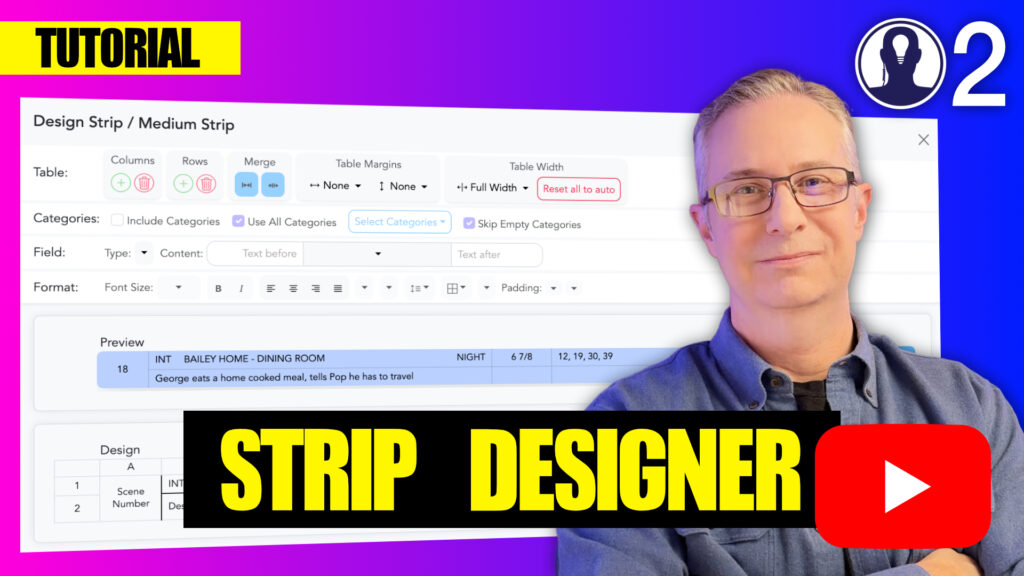
Here is a video that covers designing a strip:
Updated on April 23, 2025
DesignInterface

What are your Feelings

  • Happy
  • Normal
  • Sad

Share This Article :

  • Facebook
  • X
  • LinkedIn
  • Pinterest
Creating a StripDesign Strip Menu Bar – Table

Leave a Reply Cancel reply

Your email address will not be published. Required fields are marked *

Table of Contents
  • Understanding the Strip Designer
  • Menu Bar Sections
  • Designer Philosophy
  • Getting Started with Strip Design
  • Facebook
  • YouTube
  • Instagram
  • Bluesky
Proudly powered by WordPress